

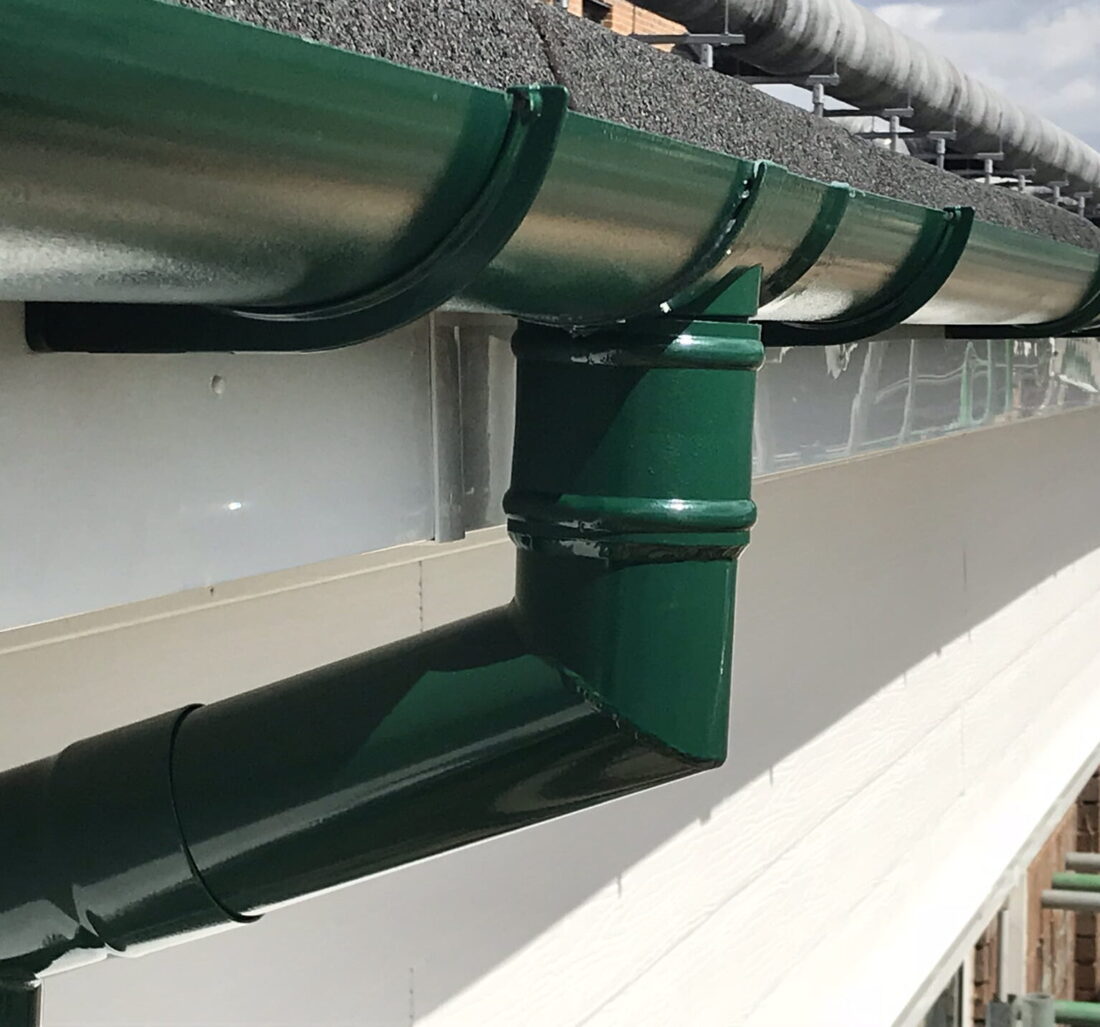
Best Gutters for Coastal Homes in the UK
Salt spray does not need to reach the roof in visible waves to affect a rainwater system. On exposed coastal sites, wind carries fine salt particles onto gutters, brackets, joints and downpipes day after day. Choosing the best gutters for coastal homes means looking beyond appearance or initial price. The system needs to resist corrosion, cope with wind-driven rain and discharge water reliably without creating an ongoing maintenance problem.
For most coastal properties, aluminium guttering is a strong long-term choice. It is lightweight, corrosion resistant, available in profiles suited to both traditional and contemporary buildings, and can be powder coated in a wide range of colours. The right specification still depends on the building, its roof area, local exposure and whether the property needs a heritage finish, a clean seamless line or commercial-scale capacity.
Why coastal guttering needs a different specification
A house a few streets inland may face very different conditions from one on a clifftop, harbour front or open estuary. Salt-laden air settles on every external surface. Combined with persistent moisture, this can accelerate deterioration in unsuitable metals and at poorly protected fixing points. Strong winds can also force rain over gutter edges, loosen inadequate brackets and put extra strain on joints.
The practical issue is not simply whether a gutter can carry rainwater. It is whether the complete system – gutter, outlets, stop ends, brackets, bolts, downpipes and hoppers – will remain secure and presentable through repeated wetting, drying and salt exposure.
Galvanised steel can be vulnerable once its coating is damaged, while untreated or poorly maintained materials may stain, corrode or require frequent repainting. Plastic systems do not rust, but can become brittle, fade or move with temperature changes over time. They can be appropriate for lower-cost work, but are not always the best fit for an exposed coastal elevation or a property where appearance matters.
Aluminium is usually the best gutter material for coastal homes
Aluminium offers a useful balance of durability, low weight and design flexibility. It naturally forms a protective oxide layer, and a quality powder-coated finish gives further protection while allowing the guttering to match windows, soffits, cladding or established heritage colours.
Unlike heavier systems, aluminium places less load on the fascia and is straightforward to handle during installation. This is valuable on renovation work where access may be restricted, as well as on new builds where clean rooflines are a priority. It is also available in a choice of cast, extruded, seamless and pressed profiles rather than forcing every project into one standard shape.
No material is maintenance-free on the coast. Salt deposits should be washed from external rainwater goods periodically, particularly on the seaward side of a building. Any accidental damage to a coating should be addressed promptly. However, a correctly specified aluminium system avoids many of the corrosion and weight issues associated with alternative gutter materials.
Do not overlook brackets and fixings
A corrosion-resistant gutter is only as reliable as the components holding it in place. Coastal specifications should give proper attention to bracket spacing, fastener quality and jointing details. Stainless steel or suitably protected fixings are generally preferable where exposure is severe, and dissimilar metals should not be allowed to create conditions for galvanic corrosion.
Bracket spacing should suit the selected profile, roof loading and manufacturer guidance. It can be sensible to use closer spacing on particularly exposed elevations, subject to the system specification. The goal is to prevent flexing, sagging and movement when a gutter is carrying a full run of water in high winds.
Match the profile to the property and roof area
The best gutters for coastal homes are not always the largest ones. Oversized rainwater goods can look out of scale on a small cottage, while an attractive heritage profile may not have sufficient capacity for a large, steep roof. Roof area, pitch, number of outlets and rainfall exposure should be considered together before ordering.
Cast aluminium for period and listed properties
Cast aluminium guttering is well suited to period houses, conservation projects and listed buildings where a traditional profile is essential. Deep-flow cast profiles can provide useful water capacity without losing the visual weight expected on an older façade. Ornamental hopper heads and traditional round or rectangular downpipes help complete the detail where the existing building character calls for it.
For a coastal renovation, the benefit is not just visual authenticity. Cast aluminium provides a durable alternative to older cast iron systems, with considerably less weight and no routine painting cycle associated with bare iron. Dimensions should be checked carefully against existing fascia lines, outlet positions and rainwater runs before selecting a replacement profile.
Extruded and seamless ogee for modern homes
Extruded aluminium guttering suits contemporary houses and straightforward replacement work. It provides crisp, consistent lines and is available in familiar ogee and other modern profiles. A seamless ogee system is particularly useful where long, uninterrupted eaves would otherwise require several joints.
Reducing the number of joints reduces potential leak points and creates a cleaner finished appearance. Seamless systems are normally formed to the required lengths for the project, so accurate site measurement matters. They are a practical option for new-build homes, extensions and larger residential elevations where a continuous run is preferred.
Pressed aluminium box gutters for high-capacity work
Box gutters are often the sensible choice for large roof areas, flat-roof interfaces, commercial units and buildings with concentrated water discharge. Pressed aluminium box guttering can be supplied in substantial dimensions, including commercial-scale options such as 200 mm x 150 mm profiles where the design calls for high capacity.
A box profile should not be specified on size alone. Outlet positions, fall, internal corners and the capacity of connecting downpipes all need to be planned. A large gutter feeding undersized downpipes simply moves the bottleneck further down the system.
Capacity matters as much as corrosion resistance
Coastal weather can involve short, intense bursts of rain driven sideways by the wind. Gutters that perform adequately in ordinary showers may overflow where roof water is concentrated at one end of a run or where valleys discharge into a single point.
As a starting point, assess the effective roof area draining to each gutter length. Then consider roof pitch, valley gutters, dormers, abutting roofs and the number of available downpipe positions. Long runs need a suitable fall towards outlets, while larger roofs may need additional outlets or wider downpipes rather than one oversized hopper.
Hopper heads can be functional as well as decorative. A correctly sized hopper can manage concentrated flow from valleys or rainwater pipes while providing a neat transition to the downpipe. On traditional homes, this is often the point where performance and architectural character can work together.
Finish and colour for exposed elevations
Powder coating is more than a colour choice on a coastal property. A properly applied finish helps protect the aluminium and provides a consistent appearance across gutters, downpipes, fascias, soffits and wall copings. Standard black remains popular on period properties, while anthracite grey, white and bespoke RAL colours are common for contemporary schemes.
Choose a finish that works with the building rather than following a trend. Dark gutters can frame pale render effectively, but they may show dried salt residue more readily on exposed elevations. Lighter finishes can soften a roofline, although they may show airborne dirt. Regular rinsing and annual inspection are usually more useful than selecting a colour solely to disguise maintenance.
Installation details that make the system last
Good materials cannot compensate for poor falls, weak fascia boards or badly positioned outlets. Before fitting, inspect the fascia and eaves for rot, movement and uneven lines. Replace or repair roofline elements where required, then establish a consistent fall to each outlet.
Sealants, joint methods and expansion allowances must suit the chosen aluminium system. Aluminium moves with temperature changes, so joints should be installed as designed rather than rigidly forced into place. Downpipes need secure clips, appropriate offsets around projections and a clear route to the drainage connection or water butt.
On exposed sites, professional measurement and fitting can remove uncertainty around profile selection, capacity and fixing arrangements. Gutters Direct can supply standard components, provide cut-and-drop materials or support a complete installation where the project requires it.
A coastal rainwater system should look right on the building, but its real value appears during the stormy months. Specify the profile around the roof’s water load, use aluminium with suitable fixings and finish, and give the system a straightforward annual clean. That approach keeps water where it belongs – away from the walls, foundations and roofline.