

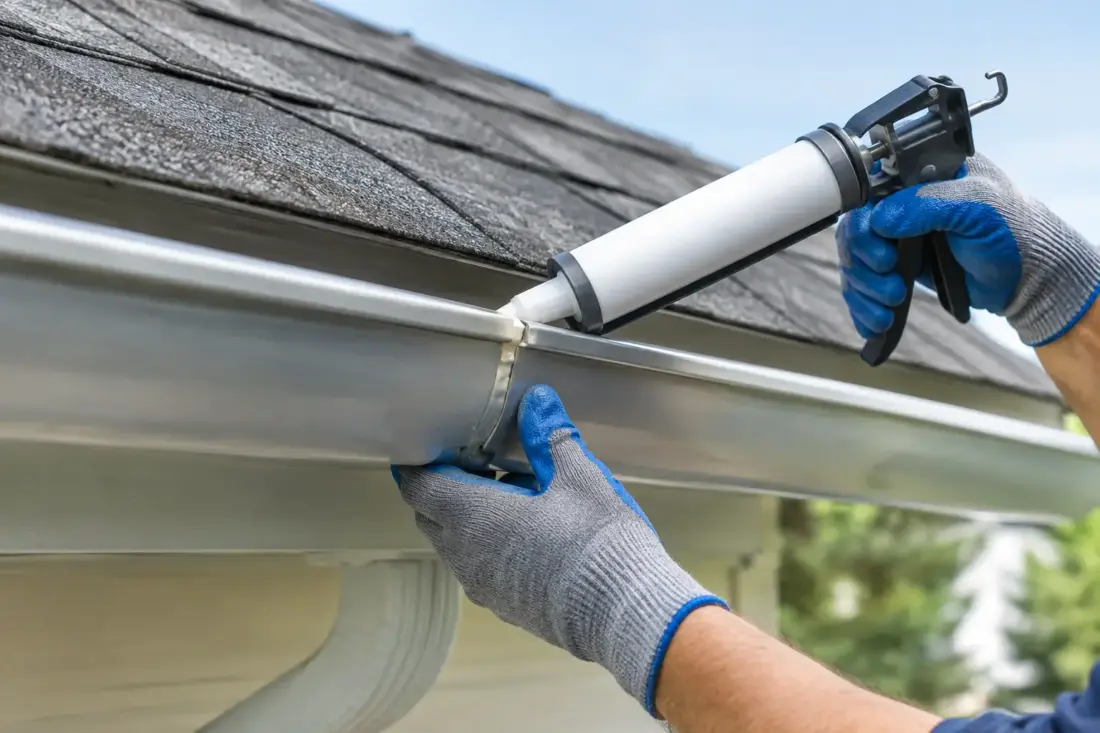
How to Repair Gutter Joints Without Repeat Leaks
A drip from a gutter joint rarely stays a small problem. Water can track behind fascias, stain masonry, saturate the ground below and, in winter, leave a slippery patch by the entrance. Knowing how to repair gutter joints properly means dealing with the reason the connection has failed, rather than applying another bead of sealant over a wet, dirty joint.
For aluminium guttering, the repair method depends on the profile and connection. A bolted cast aluminium union, an extruded system with a joint bracket, and a pressed aluminium box gutter do not assemble or move in exactly the same way. Start by identifying the system, then repair the joint with compatible components and sealant.
Find the real source of the leak first
Water does not always emerge directly below the failed joint. A blockage upstream can cause a gutter to overflow at a connection that is otherwise sound. Likewise, a gutter with insufficient fall may hold water along its base, putting every union under more pressure than intended.
Choose a dry day and use safe access. Clear leaves, moss and silt from the run, particularly around outlets and stop ends. Then inspect the joint for a split seal, loose bolts, a displaced gutter length, corrosion around fixings, or a visible gap between sections. Look closely at the gutter brackets too. If brackets have dropped, the gutter can pull away from its union or lose the designed fall towards the downpipe.
A controlled water test is more useful than waiting for rain. Run a hose gently into the gutter above the suspect area, rather than directing a high-pressure jet at the joint. Watch the water level and the underside of the connection. Test one section at a time, as a leak at an outlet or corner can be mistaken for a failed straight joint.
Before you repair gutter joints, check whether repair is sensible
A joint with an aged or damaged seal can usually be repaired. A joint repeatedly forced apart by movement, poor support or a distorted gutter section needs more than sealant.
Aluminium is corrosion resistant, lightweight and well suited to long-life rainwater systems, but it still requires compatible fittings and careful installation. Avoid mixing unidentified metals, aggressive cleaners or random fixings into an existing system. These can damage finishes or create galvanic corrosion risks where dissimilar materials remain damp.
Replacement is often the better option when the joint body is cracked, bolt holes have elongated, the socket is badly distorted, or multiple connections leak along the same run. On heritage properties, replacing a cast aluminium union with the correct profile retains the intended character far better than adapting a mismatched plastic fitting. On commercial box guttering, a persistent leak may also point to movement in the roof structure, failed lining details or insufficient outlet capacity, all of which require a broader inspection.
Tools and materials for a sound repair
The exact requirements vary by profile, but the essentials are straightforward: safe access equipment, gloves, a stiff nylon brush, clean cloths, a scraper suitable for removing old sealant, a suitable screwdriver or spanner, and a hose for testing. Keep replacement bolts, nuts and washers ready if existing fixings are corroded or no longer tighten securely.
Use a sealant approved for the gutter system and its finish. A neutral-cure, flexible exterior sealant is commonly appropriate for aluminium rainwater work, but the manufacturer’s fitting guidance should take priority. The sealant must adhere to clean, dry aluminium and allow for normal thermal movement. Hard-setting compounds can crack as the gutter expands and contracts, while excessive sealant can obstruct drainage paths or make future maintenance difficult.
If a joint bracket, union or gasket is worn, order the matching component for the gutter profile. The shape of an ogee gutter, a half-round section and a square or box profile is not interchangeable. Measure the face width, depth and profile before purchasing, and check whether the existing system is cast, extruded, pressed or seamless.
Do not seal a wet or dirty joint
This is the most common reason a quick repair fails. Remove loose debris and old failed sealant completely from the mating surfaces. Wash away grime, then allow the area to dry fully. Sealant applied over moisture, chalking powder coat, algae or old silicone may appear to hold initially but will usually release at the first period of prolonged rain.
How to repair a leaking aluminium gutter joint
Begin by supporting the gutter section. If it has slipped out of position, do not rely on the joint to carry its weight while you work. Check that the nearby brackets are sound, correctly fixed to the fascia or rafter ends, and spaced in line with the system specification.
Loosen the joint fixings carefully. On a bolted cast aluminium system, remove the nuts and bolts if necessary and separate the two gutter ends enough to clean the contact faces. On an extruded system, release the joint bracket or union according to its design. Do not force a section sideways if it is captive between corners or stop ends. It may need to be released at another fitting first.
Remove the old gasket if one is fitted and inspect it closely. A flattened, torn or hardened gasket should be replaced, not reused. Clean both gutter ends, the inside of the union and all bolt holes. A non-metallic scraper and nylon brush reduce the risk of scratching a powder-coated surface.
Apply the specified sealant in a continuous, modest bead where the system requires it. The aim is an even seal between components, not a thick external fillet. Pay particular attention to the lower internal edge of the joint, where standing water sits, and around fixing points where the manufacturer’s method calls for sealing.
Reassemble the connection squarely. Make sure each gutter length is seated to the correct insertion depth and any expansion allowance is retained. Aluminium moves with temperature changes, especially on long, dark-coloured runs exposed to direct sun. Pushing every section hard against the end of a socket can leave no room for movement and may open joints later.
Refit or replace the bolts and tighten them evenly. Overtightening can distort a cast union, crush a gasket or mark the coating. Tighten only until the joint is secure and the seal is compressed evenly. Wipe away excess sealant from visible faces before it cures, then leave it for the recommended curing time before carrying out a water test.
Correct the causes that make joints fail
A repaired joint should not be asked to compensate for poor alignment. Check the gutter run for a consistent fall towards the outlet. The precise fall and bracket spacing depend on the profile, loading and manufacturer’s guidance, but the basic rule is simple: water should drain freely without pooling.
Inspect the outlet and downpipe as well. A partially blocked downpipe can back water up into the gutter during heavy rain, causing a sound joint to spill. On larger roof areas, check that the gutter capacity and number of outlets suit the roof drainage area. This is particularly relevant for deep-flow systems, 200 mm x 150 mm box gutters and commercial buildings where a high-volume discharge can expose marginal details quickly.
Also consider thermal movement. Long extruded aluminium runs need correctly positioned joints and brackets so the system can expand and contract without stress. Where a repair has failed more than once in the same place, check whether the wrong joint type has been used or whether the gutter has been cut too tightly between fixed points.
When a professional repair is the safer route
Work at height is not a minor consideration. If access requires ladders above a conservatory, uneven ground, a busy entrance or more than one storey, arrange competent access rather than attempting a repair from an unsafe position. A professional installer can also identify profile compatibility, set falls accurately and replace affected lengths without damaging adjacent fittings.
This is especially worthwhile on listed buildings, where cast profiles and ornamental hopper heads may need a sympathetic repair, and on flat-roof or commercial schemes with pressed aluminium box gutters. Water ingress at these details can affect fascias, parapets and internal finishes before it becomes obvious externally.
For supply-only repairs, Gutters Direct can help match aluminium gutter profiles, joints, outlets and downpipes, including colour-finished components where a visible repair needs to blend into the existing system. For more complex work, a measured replacement or fitting service avoids making a local leak worse with an unsuitable part.
A clean, correctly supported joint with the right gasket, sealant and expansion allowance should stay watertight for years. If the leak returns, treat that as useful evidence: the gutter is signalling a drainage, movement or support issue that is worth correcting before the next heavy downpour.