

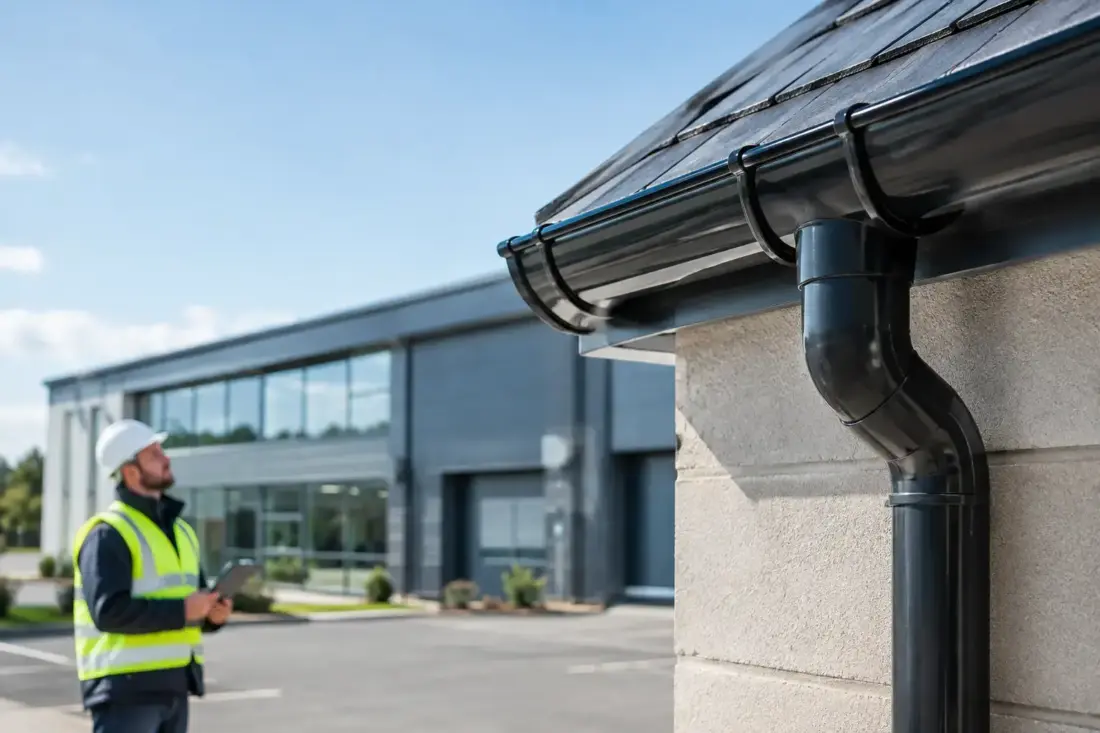
Commercial Downpipe Review for UK Projects
A commercial downpipe is rarely the feature that gets attention at handover, yet it is often where an undersized rainwater design shows itself first. Water overshoots a gutter outlet, backs up at roof level or discharges across pedestrian areas. This commercial downpipe review focuses on the decisions that prevent those problems: capacity, profile, fixing, material finish and the way the downpipe connects to the wider aluminium rainwater system.
For contractors, architects and facilities teams, the right choice is not simply the largest pipe available. The downpipe must suit the roof area, gutter capacity, outlet arrangement, building elevation and drainage point. It also needs to look appropriate on the finished building and stand up to regular weather exposure with minimal maintenance.
What a commercial downpipe needs to handle
A downpipe takes concentrated flow from the gutter outlet to the below-ground drainage system or a designed discharge point. On commercial premises, that flow can be substantial. Large roof planes, parapets, internal valleys and long gutter runs can all direct high volumes towards relatively few outlets.
The starting point is roof drainage design, not appearance. Rainfall intensity, effective roof area and the number and position of outlets determine how much water each downpipe must carry. A large box gutter may need more than one outlet along its length, even where there is space for a larger downpipe at one end. Long horizontal runs can also create a problem: water builds momentum, then reaches the outlet faster than an assumed steady flow would suggest.
This is why a downpipe should be considered alongside the gutter profile. A 200mm x 150mm commercial box gutter, for example, is intended for a different loading condition from a domestic half-round system. Pairing a high-capacity gutter with a restricted outlet or modest downpipe simply moves the bottleneck downstream.
Commercial downpipe review: the key specification checks
Match the outlet before selecting the pipe
The outlet is the transition point between gutter and downpipe, and it deserves more attention than it usually receives. Its spigot size, shape and projected flow capacity need to match the selected downpipe. An adapter can be useful where systems change, but it should not be treated as a cure for an incorrectly sized outlet.
Check the outlet position too. Outlets located close to corners or changes in gutter direction are easier to conceal, but may not provide the best drainage arrangement. On wide elevations, distributing outlets can reduce peak loading and limit the consequences if leaves or debris partially obstruct one location.
Choose a profile that suits the building and flow
Round, square and rectangular aluminium downpipes all have their place. Round profiles can sit comfortably with traditional cast aluminium gutters and heritage-style hopper heads. Square or rectangular downpipes often suit contemporary elevations, where crisp lines complement modern ogee or box guttering.
The profile is not purely aesthetic. Internal area, bends and branch connections affect flow. A rectangular downpipe can offer useful capacity and sit close to the wall, while a round profile may be the better visual match for a period property. Where a listed building or conservation setting is involved, the visual relationship between gutter, hopper head, downpipe and brackets should be considered early, rather than treated as a late-stage detail.
Allow for bends, offsets and access
Straight runs perform best, but site conditions do not always allow them. Eaves projections, stone string courses, canopies, signage and services can require offsets. Every bend introduces resistance and creates a point where debris may gather, particularly where the pipe receives water from a leaf-prone roof.
Keep offsets as short and direct as possible. Specify access where cleaning will be needed, especially at hopper heads, rainwater heads and changes of direction. A downpipe may look tidy when hidden behind cladding or within a service zone, but it still needs to be inspectable. Concealed pipework without a practical maintenance route can turn a simple blockage into an expensive investigation.
Specify brackets for the exposure and substrate
A commercial downpipe is only as dependable as its fixing arrangement. Bracket spacing should follow the system guidance and take account of pipe length, wind exposure, building height and the substrate behind the façade. Masonry, insulated render, rainscreen systems and steel-framed walls each require a considered fixing method.
Do not rely on standard fixings where the wall construction cannot support them. Coordinate brackets with cladding rails, backing boards or structural zones before installation begins. For vulnerable ground-floor elevations, anti-vandal or heavy-duty arrangements can be sensible, particularly at schools, public buildings, service yards and retail premises.
Why aluminium is well suited to commercial drainage
Aluminium brings several practical advantages to commercial rainwater projects. It is lightweight, corrosion resistant and available in a wide range of profiles, from traditional cast components to extruded and pressed aluminium systems. That makes it possible to maintain a consistent material and finish across gutters, hopper heads and downpipes.
Powder coating is particularly useful where rainwater goods form part of the external design. Downpipes can be specified to coordinate with window frames, fascias, cladding or heritage colour schemes rather than defaulting to a limited stock colour. The finish should be selected with the surroundings in mind. Very dark colours can show marks more readily, while light finishes may need more visible cleaning on busy elevations.
There is a trade-off. Aluminium systems have a higher initial material cost than basic plastic alternatives, and careful handling is needed to avoid finish damage during installation. On commercial work, however, the longer service life, lower weight and professional appearance often make aluminium the more sensible whole-life choice. Replacement sections and matching components should also be considered at procurement stage, particularly for phased developments or estates with multiple buildings.
Installation details that affect long-term performance
Good drainage performance depends on installation discipline. Pipes should be plumb, securely bracketed and connected so that water remains within the system at every joint. Ensure the base connection is compatible with the drainage arrangement and protected from movement or impact where necessary.
Thermal movement is another practical consideration. Aluminium expands and contracts with temperature changes, so joints and fixing points must follow the manufacturer’s installation requirements. Over-tightening, forcing misaligned sections together or painting over moving interfaces can create future problems.
The top connection needs similar care. If a hopper head is used, it should be adequately supported and proportioned for the incoming flow. Hopper heads can add architectural character on traditional buildings, but they are also useful collection points where multiple gutters meet. Their capacity and outlet size must be designed for the duty, not selected on appearance alone.
On refurbishment projects, inspect the existing below-ground drainage before replacing visible rainwater goods. A new high-capacity gutter and downpipe can expose a blocked or undersized gully that was previously receiving less flow. The water path should be reviewed from roof edge to final discharge.
A practical approach to selection
For a straightforward commercial elevation, begin by confirming the roof catchment and gutter capacity, then establish the required number of outlets and downpipes. Select the profile and size around that calculation, not around the nearest existing pipe. Next, check wall build-up, bracket positions, offsets and drainage connections. Finally, choose the finish and any heritage or anti-vandal details required by the project.
Complex roofs benefit from early technical discussion, especially where box gutters, parapets, internal drainage transitions or bespoke colours are involved. Gutters Direct Online can supply aluminium rainwater components for supply-only requirements, cut-and-drop orders or complete fitting support, helping project teams coordinate a practical system before materials reach site.
A commercial downpipe should disappear into the building’s operation: it carries water where it needs to go, complements the elevation and remains accessible when maintenance is due. Give it the same early attention as the gutter and outlet, and it is far less likely to become the source of an avoidable call-back.