

Period Property Rainwater Restoration Guide
A failed gutter on a period house rarely stays a gutter problem. Water spills onto brickwork, saturates timber eaves, marks render and can overwhelm drains at the base of the wall. This period property rainwater restoration guide sets out how to assess the existing system, retain the building’s character and specify aluminium components that will manage rainfall reliably for years to come.
Start with the building, not the replacement gutter
Period properties were built around a wide range of roof pitches, eaves details and drainage arrangements. A Victorian terrace may have a deep moulded gutter and decorative hopper heads, while an Edwardian house may use larger downpipes and long gutter runs feeding a shared outlet. Replacing a damaged section with the nearest available modern profile can alter the elevation and leave the system under-sized.
Start with a ground-level visual inspection, then arrange safe access for a closer survey. Record the existing gutter profile, its width and depth, bracket spacing, downpipe diameter, outlet positions and the total length of each run. Take clear photographs of corners, stop ends, hoppers, offsets and any ornamental details before removal begins.
Look beyond obvious holes and corrosion. Persistent overflow may be caused by incorrect falls, a blocked underground drain, too few outlets or a roof area that has been extended since the original system was installed. A sound restoration deals with the complete route of the water, from roof edge to drainage point.
Check where water is causing damage
Water staining beneath joints usually points to failed seals, movement or inadequate support. Damp patches around the eaves can indicate overflowing gutters, but may also result from slipped tiles, defective flashings or a leaking valley. Decayed rafter feet, fascia boards and soffits should be examined before new gutter brackets are fixed.
Pay particular attention to internal corners and valley outlets. These locations receive a concentrated flow during heavy rain and are often the first parts of an older installation to fail. If there is standing water in a gutter after rainfall, the run may need re-setting rather than simply re-sealing.
Match the rainwater profile to the period
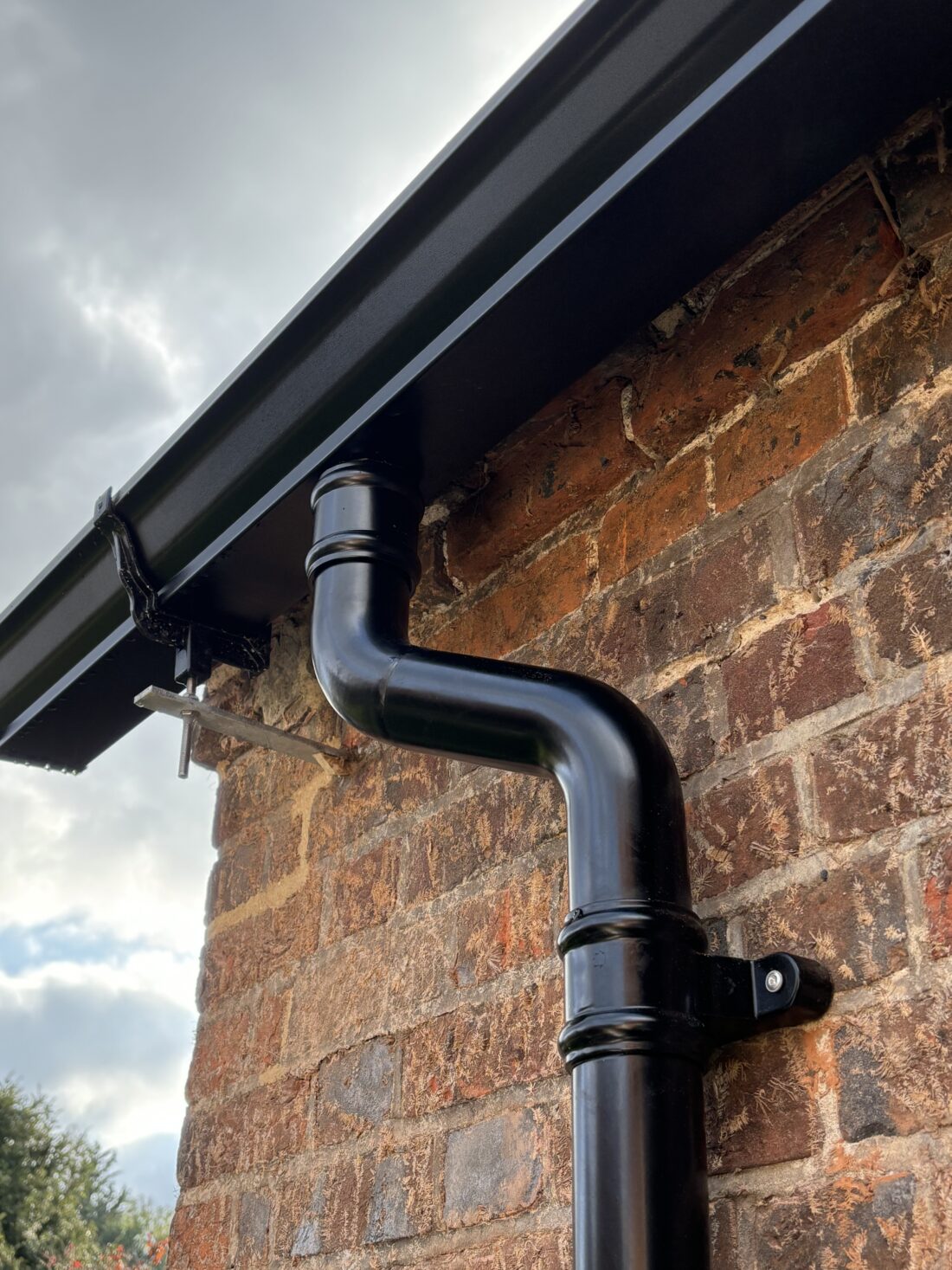
A heritage-appropriate profile does not mean accepting the maintenance burden of old cast iron. Cast aluminium guttering can reproduce the substantial appearance and crisp detailing associated with traditional systems while providing a lighter, corrosion-resistant alternative. It is particularly suited to listed buildings, conservation areas and properties where the original elevation matters.
Half-round profiles are common on simpler traditional elevations. Ogee and moulded profiles provide a more decorative line and often suit Victorian and Edwardian buildings. Box gutters may be appropriate where the original detail is concealed behind a parapet or built into a valley, although these need careful capacity and waterproofing design because a blockage can have more serious consequences.
Downpipes and hopper heads should be considered as part of the same elevation. A plain modern plastic downpipe beside an ornate original hopper can look out of place even where the gutter line itself is correct. Aluminium downpipes are available in round and rectangular forms, with swaged ends and offsets to suit traditional arrangements. Decorative hopper heads can retain visual character while providing a practical collection point between gutter and pipe.
When to repair rather than replace
If existing cast iron is structurally sound, local repair can be the right decision, particularly on a listed building. Small cracks, loose joints and isolated corrosion may be repairable after cleaning, preparation and coating. However, repeated patching is rarely good value where long runs have thinned, brackets are failing or leaks occur at multiple joints.
Replacement is often the more dependable route when the system has reached the end of its life or when access costs make repeated repairs uneconomic. The key is to replace like for like in visual scale and profile, not necessarily in material. Any listed building consent or conservation area requirement should be confirmed with the local planning authority before work starts. Requirements vary, especially where original rainwater goods contribute to the significance of the property.
Size the system for the roof, not the old fittings
Original gutters are not automatically the correct size for present conditions. Extensions, roof alterations, changed drainage layouts and more intense downpours can all expose capacity limits. A replacement system should be sized against the effective roof area, roof pitch, gutter run length, outlet positions and local rainfall intensity.
A long rear roof slope draining to one outlet needs more capacity than the same roof divided between two downpipes. Valleys also increase the amount and speed of water entering a gutter. In these cases, increasing the outlet size, adding a downpipe or selecting a deeper profile may be more effective than fitting a wider gutter alone.
This is where a sympathetic restoration and a technically correct installation have to work together. A visible front elevation may require a traditional cast aluminium profile, while a concealed rear elevation can sometimes use a higher-capacity extruded aluminium or pressed aluminium box gutter. The best choice depends on what is visible, how the roof drains and what the existing structure can support.
Do not overlook the drainage below ground. Water discharged from a new, high-capacity system still needs a clear gully, drain or properly designed rainwater soakaway. Testing the outlet during the survey can prevent a new gutter being blamed for a blocked drain.
Gutterdirectonline
Aluminium is a strong fit for period property restoration because it combines low weight with durability and a broad choice of profiles. Unlike untreated cast iron, it will not rust. It is also easier to handle during installation, which can be helpful where access is restricted or work is taking place around retained slates, leadwork and delicate eaves details.
Powder-coated finishes allow gutters, downpipes and hopper heads to be colour matched to existing joinery, window frames, roof details or a heritage colour scheme. Black remains a traditional choice, but dark grey, heritage greens and bespoke colours can be specified where the building calls for it. The finish should be selected early, as it affects every visible component, including brackets, bends and stop ends.
Aluminium systems are available in cast, extruded and pressed forms. Cast aluminium gives the weight and appearance associated with heritage guttering. Extruded aluminium offers accurate, consistent sections and is well suited to many standard runs. Pressed aluminium is often used for box gutters and larger commercial-scale requirements. The right construction is determined by the profile, capacity and visual result required, rather than one being universally better than another.
Installation details that prevent repeat failures
Even a correctly selected gutter will fail if the fixing and falls are wrong. Brackets need secure fixing into sound timber, masonry or suitable fascia support. Replacing rotten timber and then fixing to a stable substrate is preferable to packing out old boards and hoping the line holds.
Set the gutter with a consistent fall towards the outlet. The required fall is modest, but it must be continuous. Excessive fall can look poor on a long, prominent elevation, while too little leaves water standing and increases debris build-up. On long runs, careful setting out before fixing brackets is essential.
Allow for movement at joints and use the manufacturer’s specified connectors, seals and fixings. Mixing components from different systems can create poor fits and inconsistent expansion allowances. Where downpipes pass around stone string courses, bay windows or projecting details, use correctly positioned offsets rather than forcing the pipe out of line.
For larger properties, multi-storey work or difficult access, professional installation offers clear advantages. It reduces the risk of damage to roof coverings and ensures outlets, angles and bracket centres are set correctly. Gutters Direct can supply standard or tailored aluminium rainwater components, arrange cut-and-drop delivery, or support a complete fitting requirement where needed.
Plan maintenance into the restoration
A restored system should not be left until the next leak appears. Clear gutters and valley outlets at least once a year, and more often where trees overhang the roof. Check for debris at hoppers, signs of movement at brackets and discharge from downpipes during heavy rain.
Avoid relying on gutter guards as a universal answer. Some can reduce larger debris but still hold fine material, and poorly fitted guards can restrict flow at an outlet. Their suitability depends on the roof, nearby trees and the ease of safe future access.
A well-chosen aluminium system should preserve the proportions of the property while giving the owner a more manageable, durable rainwater solution. Get the survey, profile and capacity right before ordering, and the finished work will protect the building quietly rather than becoming its next repair project.