

Roof Valley Drainage Guide for UK Properties
A roof valley collects water from two roof slopes and concentrates it into one narrow route. That makes it one of the first places to assess when planning a rainwater system. This roof valley drainage guide explains how to move that concentrated flow safely from the roof covering into gutters and downpipes, without compromising the building’s appearance or creating a future maintenance problem.
For a small pitched extension, the answer may be a correctly formed valley lining and a standard aluminium gutter. On a large slate roof, a concealed box gutter, multiple outlets or oversized downpipes may be needed. The right arrangement depends on roof area, pitch, valley length, local exposure and where the water can discharge.
Why roof valleys need separate drainage planning
Water does not arrive at the eaves evenly. Each slope drains towards the valley, where the flow accelerates and carries debris with it. A valley that looks modest in dry weather can deliver a substantial volume of water during a heavy downpour, particularly where one or both roof slopes are steep.
If the outlet at the bottom of the valley is too small, water can overshoot the gutter, back up beneath tiles or slates, or spill onto walls and windows. Repeated overflow may stain masonry, saturate fascias and soffits, and contribute to damp around openings. On commercial roofs, it can also overload lower-level gutters that receive water from upper roofs.
The challenge is not simply fitting a larger gutter. The entire route must work together: the valley lining, the valley outlet, the receiving gutter, its fall, the downpipe capacity and the drainage point at ground level. A weak point anywhere in that sequence can control the performance of the whole system.
Roof valley drainage guide: assess the catchment first
Start by identifying the roof area feeding each valley. Measure the plan area of both roof slopes, then allow for roof pitch where a more accurate assessment is required. A roofing contractor, architect or drainage designer can calculate the effective catchment and local design rainfall intensity for a project where capacity is critical.
For domestic work, the practical questions are often just as useful. Does the valley receive water from a dormer, rear addition or higher roof? Is there a second valley joining above it? Does the property sit in an exposed coastal, upland or high-rainfall location? Are nearby trees likely to send leaves, moss and twigs towards the outlet?
A short, open valley on a detached bungalow presents a very different loading condition from a long valley between two roof wings on a three-storey house. Do not size both details by appearance alone.
Consider how water leaves the valley
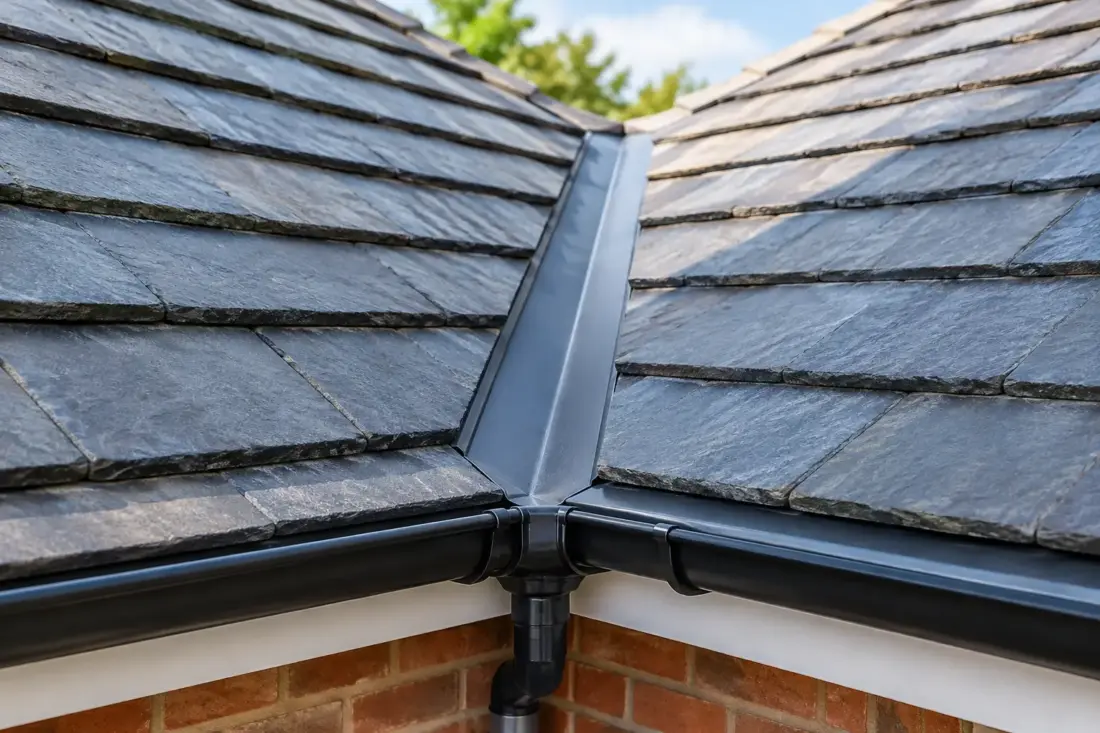
At the base of the valley, water commonly enters an eaves gutter, a box gutter or a purpose-made valley outlet. The outlet must sit in the natural line of flow and must not be obstructed by raised tile edges, poorly positioned clips or an abrupt change in level.
Where the valley discharges directly into an eaves gutter, ensure the gutter is set low enough and far enough forward to catch the flow. A gutter installed tight against the fascia can be awkward to clean and may not catch water travelling at speed off a steep valley. The detail should also allow roofers to maintain the valley lining without dismantling the rainwater system.
On larger roofs, a pressed aluminium box gutter can provide higher capacity and a clean architectural finish. Box gutters are particularly useful where the drainage needs to be concealed behind a parapet or within a roof junction. They must be designed with reliable falls, accessible outlets and an overflow strategy where appropriate. Concealed drainage can look excellent, but it gives less warning when leaves or silt build up.
Choose a gutter profile that matches the flow
The receiving gutter should be selected for calculated capacity rather than to match an existing profile by default. Deep-flow ogee, half-round and box profiles each have a place. Traditional cast aluminium gutters suit period properties where architectural character matters, while extruded aluminium systems offer crisp lines, low weight and straightforward handling on contemporary work.
For substantial catchments, commercial-scale aluminium guttering is often the sensible choice. A 200 mm x 150 mm box gutter, for example, is intended for much heavier flows than a standard domestic eaves gutter. It may be suitable beneath large valley outlets, but the downpipes and drainage connections still need to keep pace.
Aluminium is a strong option for valley-related rainwater work because it is corrosion-resistant, lightweight and available in a wide range of profiles and powder-coated colours. It can be coordinated with fascias, soffits, windows or heritage finishes without accepting the short life associated with some lower-cost alternatives. Material choice does not compensate for undersized drainage, however. Correct falls and outlet sizing remain the priority.
Downpipes are often the limiting factor
A generous gutter can still overflow if it feeds into one undersized downpipe. This is particularly common where a roof valley discharges close to a stop end and the water has only one route away.
Position downpipes near the point where valley flow enters the gutter whenever the elevation and architectural layout allow it. A hopper head can be useful where several flows combine or where a larger visual collection point is required. On traditional buildings, an ornamental hopper can complement cast aluminium gutters and downpipes. On modern schemes, a plain hopper or direct outlet may give a cleaner result.
More than one downpipe may be necessary for a large gutter run, a multi-valley roof or an exposed elevation. There is a trade-off: additional downpipes improve capacity and reduce the distance water travels in the gutter, but they affect the façade and require suitable below-ground drainage connections. They should be positioned to respect windows, doors, access routes and listed-building constraints.
Detail the valley lining and interfaces properly
The valley lining is not part of the gutter system, but it has a direct impact on drainage performance. Lead, zinc and proprietary valley systems are all used, depending on roof finish, specification and conservation requirements. The lining needs adequate width, correctly formed upstands where needed, proper support and allowance for thermal movement.
A narrow valley can be overwhelmed by wind-driven rain or debris before the water reaches the gutter. Conversely, a very wide exposed metal valley may look out of place on a traditional roof. The roof covering, valley width and architectural context should be considered as one detail.
Avoid relying on sealant as the main defence against poor geometry. Sealants have a role at certain junctions, but the valley should shed water through laps, falls and properly formed outlets. This is especially important on roofs exposed to freeze-thaw cycles, solar movement and routine maintenance traffic.
Where new aluminium guttering meets existing roofline materials, check the condition of fascia boards, eaves carriers and fixings. Aluminium is light, but a water-filled gutter and snow loading can place real demands on the support arrangement. Use suitable brackets at the recommended centres, establish the intended fall before fitting, and ensure joints remain accessible for inspection.
Plan for leaves, moss and maintenance access
Roof valley drainage fails most often through restriction rather than dramatic material failure. Moss from old tiles, leaves from overhanging trees and granules from deteriorating roof finishes collect where the valley meets the gutter. If the outlet sits beneath a leaf guard that has not been checked, the guard itself can become the blockage.
A debris-control measure can be worthwhile, especially below mature trees, but it must suit the roof and be easy to inspect. Fine mesh may reduce leaf entry while trapping moss. Coarser guards are easier to rinse through but will not stop smaller material. There is no fit-and-forget option on a heavily shaded roof.
Build maintenance into the specification. The valley outlet, gutter interior, hopper and downpipe shoes should be reachable safely. For commercial sites or high-level domestic roofs, arrange planned inspections rather than waiting for staining or overflow to appear. Checking after autumn leaf fall and after major storms is sensible.
When to use professional design and installation support
A roofer can usually address a straightforward replacement valley and gutter run. Bring in more detailed technical support where there are concealed gutters, parapets, internal outlets, large commercial roof areas, listed-building requirements or recurring water ingress. These situations need a coordinated view of roofing, rainwater goods, falls, overflows and drainage connections.
For supply-only projects, accurate dimensions, photographs and a clear description of the roof junction will help identify a suitable aluminium profile, outlets, brackets and downpipes. For complex work, a cut-and-drop service or professional installation can reduce site alterations and help ensure the system is fitted to the intended falls. Gutters Direct Online can advise on aluminium gutter profiles, colour finishing and project-specific components for both traditional and modern roofs.
Before ordering, follow the water from the top of the valley all the way to the drain. If every stage has sufficient capacity, a clear fall and practical access for cleaning, the finished detail is far more likely to stay dry when the weather is at its worst.