

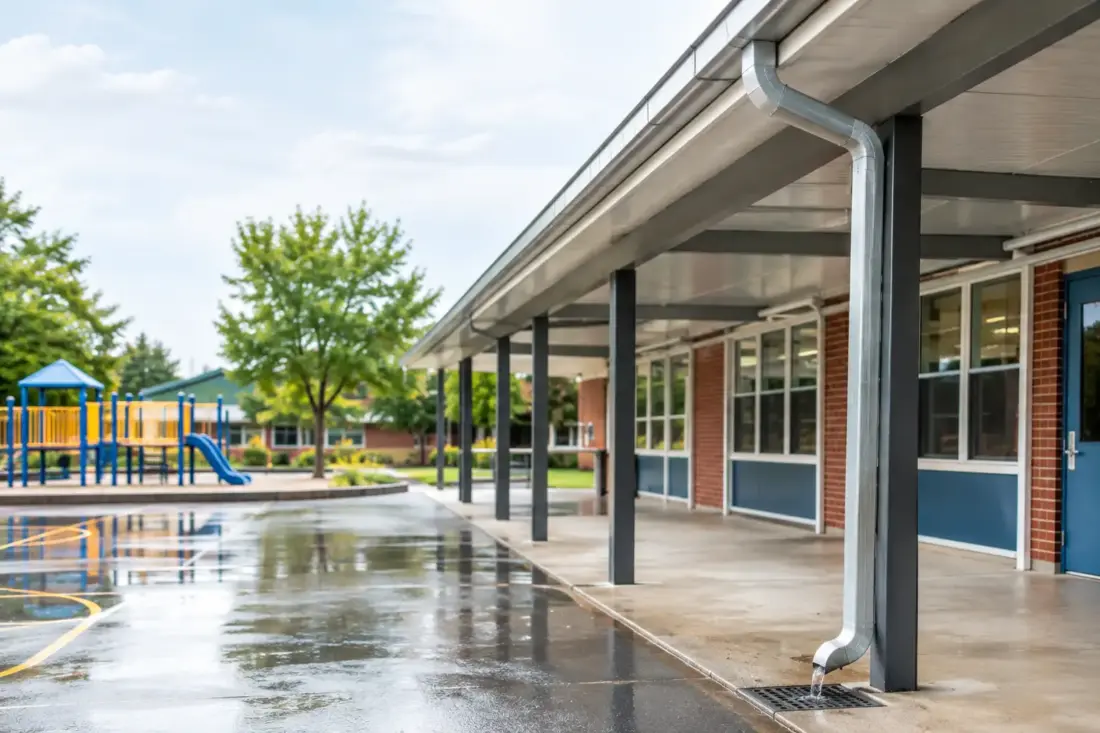
School Canopy Drainage for Safer Grounds
A canopy can keep pupils and staff out of the rain, yet it can create a concentrated drainage problem at the point where people enter the building. Effective school canopy drainage is not simply a matter of fitting a short length of gutter. It must collect water from the canopy, move it safely away from doors and routes, and remain dependable through busy term times, heavy rainfall and routine cleaning.
For estates teams, contractors and specifiers, the priority is straightforward: avoid standing water, overflowing gutters and downpipes positioned where they are likely to be damaged. The right aluminium rainwater system can provide a long service life with low weight, colour-matched finishes and profiles suited to both modern covered walkways and traditional school buildings.
Why school canopy drainage needs careful design
A small entrance canopy may appear to have limited roof area, but its drainage has little margin for error. Water is often directed to one or two low points, and a blocked outlet can quickly send it over the front edge or back towards the wall. During drop-off and collection, that overflow lands exactly where footfall is highest.
Covered walkways present a different challenge. Their long, narrow roof shape can feed substantial volumes towards a limited number of outlets, particularly where several canopy sections fall to the same end. If the gutter is undersized or the downpipe route is restricted, water can spill onto paving, splash against cladding and leave slippery areas in cold weather.
The design also has to consider the school environment. Balls, bicycles, bins and maintenance equipment can strike low-level pipework. Pupils may lean against it or use it as a handhold. Drainage components therefore need secure brackets, sensible positioning and, where exposure is unavoidable, suitable protection or anti-vandal detailing.
Start with the canopy, not the gutter profile
Gutter selection should follow an assessment of the canopy itself. Measure its plan area, roof pitch, length and direction of fall. A shallow mono-pitch canopy, for example, concentrates water along one edge. A glazed canopy can shed water quickly, while a deeper roof with a parapet may conceal an internal outlet arrangement that requires access for inspection.
Local rainfall intensity matters too. A system that appears adequate in ordinary showers may not cope with a short, intense downpour. The gutter must have enough capacity for the effective roof area and enough freeboard to manage temporary surges without overflowing. On larger canopies, it is often better to introduce additional outlets or downpipes than rely on one oversized run and a single discharge point.
Outlet positions need just as much attention as gutter capacity. Water should not pass across an entrance threshold, flow over a pedestrian route or discharge close to foundations without an appropriate connection to the drainage system. Where the existing underground drainage is limited, the proposed arrangement should be checked before installation rather than assuming a new downpipe can be added without consequence.
Allow for movement and falls
Long aluminium gutters expand and contract with temperature changes. This is normal, but the installation needs correctly positioned brackets, joint allowances and expansion details where required by the system. For continuous or seamless runs, planned outlet locations and falls become especially important because they cannot be treated as an afterthought on site.
A consistent fall towards outlets helps keep water moving and reduces the build-up of silt. Over-pitching is not a substitute for capacity, however. A gutter that is too small can still surcharge in heavy rain, while poor support can create low spots that hold water and debris.
Choosing aluminium gutters for school canopies
Aluminium is well suited to school canopy drainage because it combines corrosion resistance with low weight. It is easier to handle than many heavier alternatives, while offering a neat, durable finish for exposed entrances and walkways. Powder coating also allows gutters, downpipes and fittings to be matched to canopy frames, cladding, window systems or school colours.
The appropriate profile depends on the roof and required flow rate. Extruded aluminium gutters provide clean lines and accurate sections for contemporary canopies. Pressed aluminium box gutters are often a practical option where greater capacity is needed, including wide commercial canopy runs. A modern ogee profile can work where a more traditional appearance is required without compromising the specification.
For a heritage school or a building within a conservation setting, cast aluminium guttering and ornamental hopper heads may be more appropriate. These profiles can retain period character while delivering the weather resistance expected from a modern aluminium system. The key is not to select a heritage profile on appearance alone: its outlet size, bracket spacing and capacity must still suit the canopy roof.
Downpipes should be sized with the gutter and outlet, rather than chosen independently. A large gutter feeding a restricted downpipe simply transfers the bottleneck. Round, rectangular and swaged aluminium downpipes each have their place, depending on capacity, architectural preference and fixing conditions. At vulnerable low levels, a stronger arrangement, protective guard or carefully rerouted pipe may be worthwhile.
Details that prevent common failures
The majority of canopy drainage issues arise at junctions and outlets, not in the straight gutter lengths. Stop ends, running outlets, angles and unions should be compatible components from the same system. Mixing profiles or adapting parts without checking dimensions can lead to weak joints, awkward falls and leaks that only become obvious after the first prolonged rainfall.
Pay particular attention to the back edge of the gutter. Water should enter it cleanly from the roof covering or flashing, without tracking behind the gutter onto the fascia or canopy structure. On flat or low-pitch canopies, edge trims and drips need to project sufficiently to prevent water running back underneath.
Downpipe clips must be fixed into sound substrate at suitable centres. Fixing into thin cladding, deteriorated timber or unsupported sheet material risks movement over time. Where a canopy is attached to a lightweight frame, the installer may need to introduce backing plates or use the structural members rather than simply follow a convenient line.
Discharge arrangements deserve a final check. Downpipes can connect into surface-water drainage, hoppers or a designed rainwater harvesting system, subject to the site arrangement. They should not be allowed to empty directly onto a route used by pupils unless a proper channel drain or other controlled collection method is in place. The aim is to keep water moving away from the building and walking surfaces, not merely away from the gutter.
Plan maintenance into the installation
School sites are busy, and drainage maintenance can be postponed until a visible failure occurs. A practical design makes inspection possible without unnecessary access equipment or disruption. Outlets should be reachable, leaf guards should be removable for cleaning, and hopper heads should not be positioned where debris can accumulate unnoticed.
Canopies beneath mature trees need more frequent checks during autumn. Fine debris is often as troublesome as leaves because it settles in gutter bases and around outlet grates. Flat canopy roofs may also need separate roof-level inspections, since a clear gutter cannot solve ponding caused by blocked roof outlets or inadequate falls.
A sensible maintenance routine should include gutter clearing, outlet testing, checks for loose brackets and clips, and a visual review of downpipe connections after severe weather. Any recurring overflow should be investigated as a design or capacity issue, rather than repeatedly treated as a cleaning problem.
When a bespoke drainage arrangement is the better option
Standard lengths and fittings are suitable for many simple canopies. They are not always the best answer for a long covered walkway, an irregular entrance feature or a refurbishment where existing levels dictate the outlet positions. Bespoke aluminium lengths, formed angles and colour-matched components can reduce unnecessary joints and produce a cleaner finish.
This is also where early technical input saves time. A contractor may need cut-to-length sections for a phased installation, while an architect may require a box gutter that aligns with a concealed fascia detail. Gutters Direct can advise on aluminium profiles, downpipe options, finishes and supply or fitting arrangements where a project requires more than an off-the-shelf layout.
The most reliable school canopy drainage is usually the least noticeable. When gutter capacity, outlet placement, secure fixings and routine access are considered before installation, pupils can use the entrance or walkway as intended – without rainwater becoming the next facilities issue.